How to choose the best commercial water leak detection system
A commercial building does not have a detection problem. It has a response problem. The systems below all find water. What separates them is what happens in the two minutes after the alert. This guide gives you a five-point way to evaluate any commercial water leak detection system, then compares the vendors most often shortlisted in multifamily and commercial portfolios.
What makes a commercial water leak detection system good
The best commercial water leak detection system is the one that turns an alert into water actually shut off, fast, with a record an insurer will accept. Detection is the easy part. Almost every vendor detects. The differences that matter at building scale are coverage, connectivity, commissioning, response and proof.
Use these five questions to evaluate any system. We call them the 5 Cs.
The 5 Cs of commercial water protection
Coverage
Does it protect the whole building with point-of-leak sensors, flow meters at the riser or unit and shutoff valves, or just one of those? A flow meter sees a usage anomaly. A spot sensor sees water on the floor. Commercial buildings need both, plus a valve that can actually close.
Connectivity
Will the signal survive a concrete high-rise? Wi-Fi drops behind elevator cores and poured concrete. Purpose-built low-power networks (LoRaWAN) and cellular backhaul are designed for the building, not the apartment.
Commissioning
Can it protect the building during construction and stay through occupancy, or is it a residential kit retrofitted in? Coverage that starts at rough-in and continues into operations means one network, one record, no re-install.
Response
When the alert fires, who acts? An app notification waits for someone to read it. A live monitoring center confirms the alert lands, coordinates or triggers shutoff and calls your team. Eddy's measured path is detect, alert, escalate, isolate, about two minutes from alert to action.
Proof
Does every event close with documentation an insurer will accept at renewal? A documented response history is what supports premium savings of up to 20%, with deductible reductions of up to 80% documented at individual properties.
Commercial water leak detection systems, compared
Six systems commonly shortlisted for commercial and multifamily buildings. Each line is a neutral summary. Follow the link for the full side-by-side.
Eddy: intelligent water protection
Managed water protection: point-of-leak sensors, flow metering, automatic shutoff and a 24/7 live monitoring center, run as one program from construction into operations. Eddy supplies its own sensors, meters and valves, and a live operator works every event.
See how it worksWint
Flow-first AI detection with autonomous shutoff and a staffed control center. It carries no point-of-leak sensors of its own, so it reads a flow anomaly rather than the exact source.
CompareAlertLabs
Easy-to-install cellular sensors feeding the AlertAQ analytics and alerting platform. Alerts route through an automated dialer rather than a live water-incident team.
CompareKairos Water
A LoRaWAN sensor network with metering and shutoff, built around US multifamily. Real-time alerts go to building staff, with no staffed monitoring center behind them.
CompareProSentry
LoRaWAN strip sensors with optional gas detection for NYC Local Law 157 and a Chubb-approved New York discount. Detection only, with third-party central-station monitoring.
CompareBrickeye
Construction-phase monitoring tied to a builder's risk insurance partnership, with deductible buy-downs during the build. Coverage centers on construction rather than long-term operations.
CompareWhy operators pick Eddy
Most systems stop at the alert. Eddy is built around what happens next. Configurable automation covers the cases you want handled instantly. A live monitoring center takes the judgment calls. You decide where the line sits.

Three reasons operators choose Eddy
Configurable automation, not all-or-nothing
Set valves to close automatically on a confirmed event, or to wait for an operator's call. The rules follow the building, not a one-size default.
Human monitoring and response
A 24/7 live monitoring center acts on every alert, isolates the water (automatically or by coordinating with your team) and calls your contacts within minutes. Operators work from the system map and your business rules.
One program, construction to operations
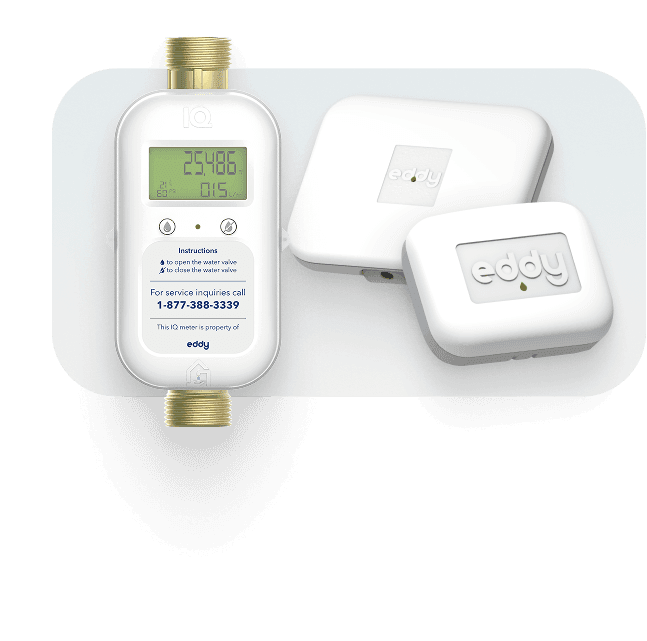
Eddy IQ for per-unit metering and shutoff, Eddy Link for building-scale meters and larger valves, Eddy H2O sensors for leak, temperature and humidity. One network, one monitoring center, one record, from rough-in to year ten.
The response layer, measured.
- Live monitoring center, staffed by trained operators
- 24/7
- Premium savings supported by documented response history
- Up to 20%
- Deductible reductions on documented programs
- Up to 80%
Frequently asked questions
Choosing a system
What is the best commercial water leak detection system?
There is no single best system for every building. The best fit is the one that matches your building on five points: coverage (sensors, metering and shutoff together), connectivity that survives concrete, commissioning that spans construction and operations, a real response layer (a live monitoring center, not just an app alert) and insurance-grade proof of every event. Eddy is built around all five, with detection, live verification, automatic or coordinated shutoff and 24/7 monitoring in one managed program.
How do I choose a commercial water leak detection system?
Score each system on coverage (point-of-leak sensors and flow metering together), control (automatic shutoff on the lines that can cascade), connectivity (a network that holds signal through concrete without touching building Wi-Fi), a monitored response chain and carrier-ready documentation. Hardware alone stops at the alert, so weight the response half heaviest.
The comparison table above shows how six commonly shortlisted systems split on exactly these criteria.
What is the difference between commercial and residential leak detection?
Commercial and multifamily buildings need network coverage that holds through concrete and elevator cores, protection at building scale (risers, zones, common areas, not just one supply line) and a response that does not depend on a homeowner reading a notification. Residential names like Phyn, Flo by Moen and FloLogic are built for a single home on WiFi. That is why commercial systems run on long-range radio like LoRaWAN with dedicated gateways instead of the building's Wi-Fi.
Coverage and control
Do I need automatic shutoff, or is detection enough?
Detection without shutoff still relies on someone getting to the valve in time. The systems that prevent loss pair detection with a valve that can close, automatically on a confirmed event or on an operator's command. Eddy detects and isolates, and a live operator stays on the event until the water is off.
Does a commercial leak detection system need building Wi-Fi?
The strongest ones do not touch it. Eddy runs every device on its own LoRaWAN network at 915 MHz, and gateways backhaul over Ethernet or LTE cellular. With the cellular option monitoring keeps running even if building internet goes down, and tenants never share a network with the system.
Insurance and lifecycle
How does leak detection affect insurance?
A documented response history, every alert verified, isolated and closed with a record, is what carriers reward. On documented programs that can support premium savings of up to 20%, with deductible reductions of up to 80% documented at individual properties. Aon's independent 2023 whitepaper found the Eddy system would have positively affected 58% of the commercial water-loss claims it studied, and even counting only the leaks that became claims, would have reduced total water damage losses by 23%.
Can one system cover construction and the finished building?
Some construction-focused platforms stop at turnover and some operational platforms only start there. A system that starts at rough-in and stays through occupancy means one network and one record across the asset's life, no second install. Eddy runs construction to operations on the same program.