Water leak detection in Orlando for commercial and multifamily buildings
Managed leak detection, 24/7 monitoring and automatic shutoff for condos, hotels and commercial buildings across Central Florida.

- 150,000+
- active smart devices in the field
- $2.26M
- in water costs saved in 2025
- 24/7
- monitoring center
Why Orlando buildings carry water risk
Orlando runs on occupancy. America's most visited destination fills one of the largest hotel inventories in the country, and a fast-growing metro keeps adding condo and apartment communities around it. In every one of those buildings the water that does the most damage usually comes from inside, not from the sky. Leaks come from failed valves and fittings, appliance hoses, HVAC and condensate connections and supply-line breaks.
Much of Central Florida's building stock went up between the late 1970s and the mid 1990s, when polybutylene supply pipe was a common choice. Chlorinated water degrades polybutylene from the inside until it turns brittle and cracks, a failure pattern that fueled one of the largest plumbing class-action settlements in US history. Air conditioning runs nearly year-round here, and humidity turns a small undetected leak into a mold problem fast.
Florida's post-Surfside rules add scrutiny on top. Condos three stories and taller face milestone inspections and structural integrity reserve studies, with inland buildings like Orlando's due for their first inspection at 30 years, and insurers are reassessing the market at the same time. Smart water leak detection meets that moment at building scale, and the same managed program protects buildings across the US and Canada.
Where leaks start in Orlando buildings
Polybutylene-era supply lines
Buildings from the late 1970s through the mid 1990s often carry polybutylene pipe that chlorinated water turns brittle from the inside. Those failures arrive with little warning, and continuous monitoring is the practical way to catch them early.
Humidity raises the stakes
A small plumbing leak that might dry out elsewhere turns to mold fast in Central Florida's humidity. Catching it early through continuous monitoring keeps remediation from getting expensive.
One leak above guest floors
Orlando fills one of the largest hotel inventories in the country nearly year-round. A concealed supply or fitting failure above occupied rooms means relocated guests and lost room-nights, so early detection and fast shutoff protect revenue as well as the building.
Rising insurance scrutiny
Florida condo associations face higher premiums, stricter underwriting and reserve funding that can no longer be waived. Documented monitoring gives boards a record that water systems are actively managed.
Smart leak detection in Orlando
A smart water leak detection system pairs wireless sensors and smart meters with automatic shutoff, so a Orlando building catches a leak in seconds instead of discovering it from a ceiling stain. Eddy runs the full stack as one managed program with a staffed 24/7 monitoring center on the chain.
Sensors plus flow intelligence
3-in-1 wireless sensors watch high-risk spaces for water, temperature and humidity while smart meters flag abnormal flow against thresholds learned from the building's own baseline.
No building Wi-Fi needed
Devices run on Eddy's own LoRaWAN network at 915 MHz, a long-range radio that holds a signal through concrete. Gateways backhaul over Ethernet or LTE cellular, and with cellular backhaul monitoring stays up even if building internet goes down.
Shutoff plus a live response
Automatic valves close the moment a configured rule fires, and Eddy's monitoring center calls the building's contacts within minutes of every alert. Every confirmed event closes with a Leak Incident Report.
See how the Eddy system works, from sensor placement to the monitoring center.
Coverage map
How Eddy works in a Orlando building.
Orlando buildings from the polybutylene era carry pipe that turns brittle from the inside, and Central Florida's humidity turns a small leak to mold fast. Turn the building to see where sensors, meters and valves sit, then run a leak through the system, from the first drop to the monitoring center's response.

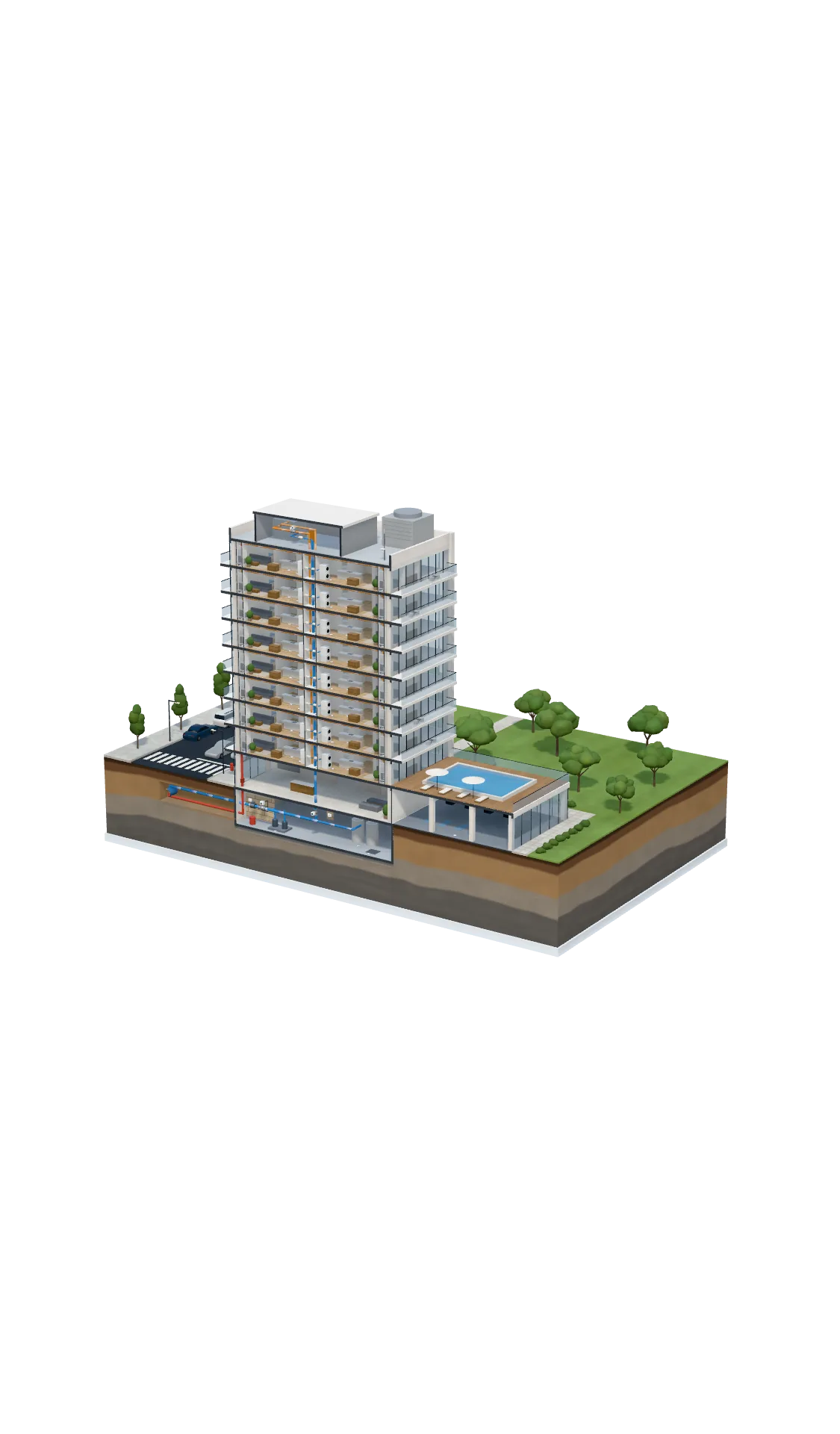
Occupied building · Business hours
Drag to turn the building. Select a label, or run a leak through the system.
The system
Detect, control and respond, in one managed program.
Sensors sit where leaks start and meters watch the flow. Valves close on the rules you set, and a 24/7 monitoring center follows each alert until your team has eyes on it.
3 layers and 16 close-ups in this building
Detect
Two ways to find a leak before it finds a unit.
Sensors sit where leaks start, and meters watch the flow for the leaks no sensor can reach.
8 close-ups · select one to zoom in
Point-of-leak
Flow-based
Control
Valves that close the water before it closes the unit.
Valves close on the rules you set, automatically on a threshold or remotely from the dashboard.
4 close-ups · select one to zoom in
Respond
A live monitoring center that closes the loop.
Alerts go through Eddy's cloud to a 24/7 monitoring center, and an operator calls your team until someone has eyes on the water.
4 close-ups · select one to zoom in
What happens in a leak, step by step
- A washing machine supply hose bursts in a suite upstairs.
- Eddy H2O under the washer detects water and sends the alert over LoRaWAN.
- The building's gateway relays it. Your team and the 24/7 monitoring center are alerted at the same time.
- A shutoff rule closes the suite's Eddy IQ valve. The water stops at the source.
- An operator confirms the alert and calls your on-site team through the escalation protocol.
Automatic shutoff is configured per building. Some sites use operator-coordinated isolation instead.
Smart sensors at every leak point
Eddy places point-of-leak sensors and smart flow meters where water damage actually starts in Orlando buildings, from the mechanical room to a laundry hose, so a leak is caught at the source and shut off before it spreads.
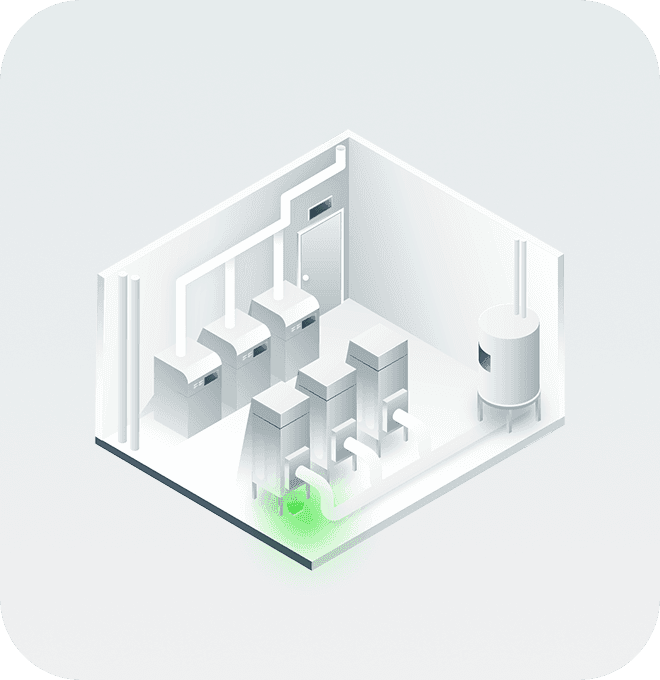
Mechanical rooms
Boilers, water heaters and main risers, where a single failure floods fast.

HVAC and fan coils
Heat exchangers and condensate lines that drip behind walls and ceilings.
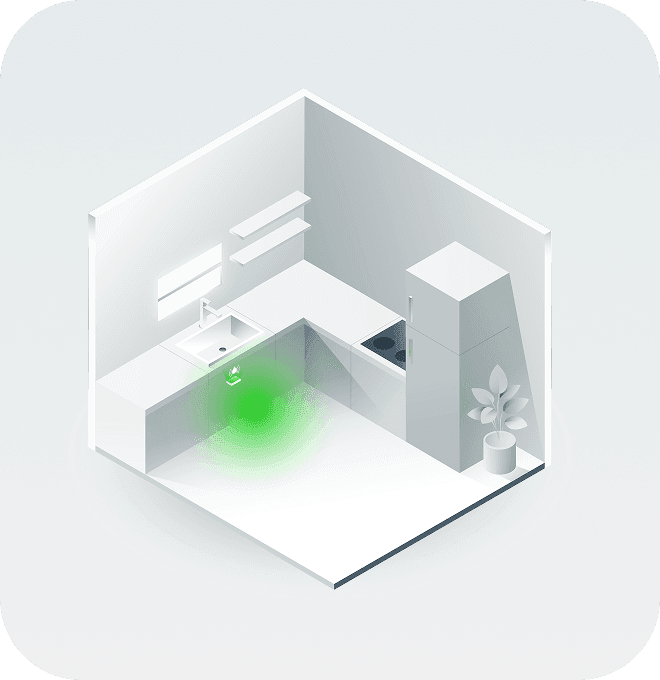
Kitchens
Supply lines, shutoffs and appliance connections under and behind the sink.
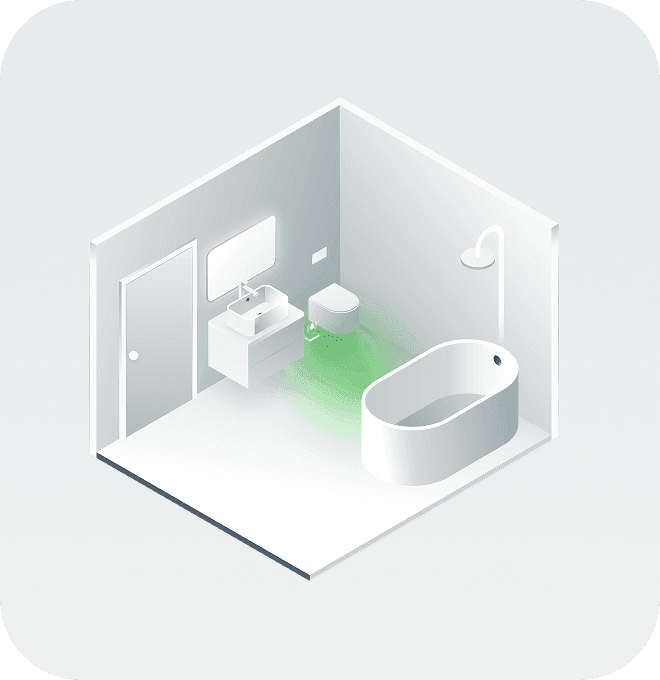
Bathrooms
Toilets, vanities and concealed in-wall fixtures on every floor.
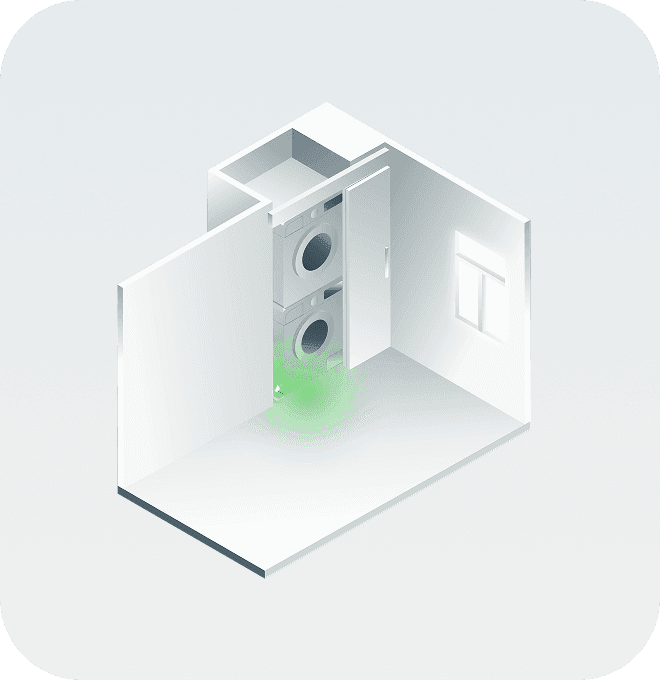
Laundry
Washer hoses and laundry connections, a top source of overnight leaks.
Every minute changes the bill.
A leak gets bigger the longer it runs. Eddy detects in seconds and the monitoring center escalates within minutes, so the same failure is contained around minute two. Unmonitored, an after-hours leak runs six to eight hours before anyone arrives.
The leak starts at minute zero. Eddy contains it around minute two. Unmonitored, the same leak runs six to eight hours before staff arrive, and that red stretch is the avoided claim.
Build your system
Design your building's leak protection.
Two minutes of quick questions gets your building the right protection, previewed instantly.
- Sized to your asset class and budget
- Modular. Adjust anything before pricing
- An Eddy team member calls soon after you submit


Sensors, meters and shutoff, backed by a 24/7 monitoring center.
What stage is the project at?
Pick one to start. We tune every question and the system around it.
 New constructionFrom breaking ground to substantial completion.
 Existing buildingInstalled in existing buildings with minimal disruption to residents and operations.
About two minutes.
Florida condo safety law (milestone inspections and SIRS)
Florida requires milestone inspections and structural integrity reserve studies for condos three stories and taller. Inland buildings like Orlando's face their first milestone inspection at 30 years and updates every 10 years after, and reserve studies now carry real funding obligations. Documented water monitoring helps associations show building systems are managed, not deferred.
A team behind every alert
A 3 a.m. alert is one chime. Nobody is awake to hear it.
Fast response is not just the hardware. The technology sees the water in seconds, and the managed service behind it, a monitoring center that calls your team within minutes, turns that into a contained event before it becomes a claim.
Tuned by real events
Built over a decade in operating buildings.
Eddy has been inside buildings since 2014. Sensor placement, alert thresholds and the monitoring-center playbook are tuned by what real water events across our monitored properties keep teaching us.
Built for the building
Sized to how the water system behaves.
Multi-family stacks, commercial towers, hospitality suites, course-of-construction projects. Each water system has its own failure pattern. The coverage map, response chain and shutoff sequence are scoped to the property in front of us, not a template.
Detect, contain, document
Every event leads to a closed incident.
Sensors find where water escaped. Automatic shutoff isolates the affected zone. The 24/7 monitoring center calls your team within minutes and stays on it until it's closed, with a Leak Incident Report on file.
Protecting buildings across North America
Eddy protects condo towers, commercial buildings and full portfolios across North America, with 150,000+ devices watched around the clock from its Toronto monitoring center. In Orlando that same managed program covers condo communities, resorts and commercial property, tuned to how each building's water system behaves.
Eddy at work in buildings like yours
Multi-family
A drip behind drywall on an upper floor. Caught in seconds, sealed before it migrated.
Vancouver, British Columbia
A concealed leak behind a fan coil on an upper floor looked like nothing from the room. A wireless sensor inside the wall cavity caught the moisture in seconds, and the superintendent sealed it before water could accumulate or migrate to other floors.
- Property manager
- Facility operator
- Asset owner
Construction
A leak at 4 AM on an empty job site. Eddy caught it anyway.
Fort Lauderdale, Florida
During active construction on a luxury development, a laundry connection began leaking in the early morning hours with the site empty. Eddy detected the moisture within seconds, the Monitoring Center prompted the on-site team, and the leak was contained before it could affect ongoing work.
- Builder or GC
- Risk manager
- Facility operator
Multi-family
An 11-storey condominium cut its insurance deductible by 80% in under a year.
Vancouver, BC
An 11-storey, 119-unit concrete condominium in Vancouver's Olympic Village retrofitted Eddy across HVAC, risers, fixtures and common areas. The deductible dropped from $250,000 to $50,000 inside the first year.
- Property manager
- Asset owner
- Risk manager
Solutions for every building
Eddy protects every asset type the same way, with monitoring and shutoff tuned to how each building's water system behaves.
Multifamily and condos
Protect every suite and riser across high-rise and mid-rise residential.
Commercial
Keep Class A offices and mixed-use towers dry, floor by floor.
Construction
Cover active sites where water damage is a leading cause of loss.
Hospitality
Guard guest floors and back-of-house without disrupting the stay.
Institutional
Safeguard campuses, hospitals and labs where contents are irreplaceable.
Industrial
Watch process water and facility systems around the clock.
Orlando water leak detection FAQ
Do you serve buildings in Orlando?
Yes. Eddy serves buildings nationwide across Canada and the US, with installation crews coordinated remotely. The monitoring center in Toronto covers every time zone, so an Orlando alert gets the same response at 3am as at noon.
Does Eddy help with polybutylene plumbing risk in older Orlando buildings?
Yes. Eddy cannot replace polybutylene piping, but continuous monitoring is the right complement to it. Point-of-leak sensors and flow monitoring catch the sudden cracks and slow seeps polybutylene is known for, often before they surface as visible damage, and the documented response supports the building's insurance conversation.
Can monitoring help with Florida's milestone inspection and reserve study rules?
Documented 24/7 monitoring gives associations a clear record that water systems are actively managed, which supports the inspection and reserve expectations Florida introduced after Surfside. Inland condos three stories and taller face their first milestone inspection at 30 years, so a monitoring history is worth starting early.
Does Eddy help during hurricane season?
Continuous monitoring matters most when buildings are stressed, and Hurricane Ian showed Orlando floods even far from the coast. Eddy watches flow and the presence of water around the clock, and its water-escape sensors can flag intrusion, like storm water reaching a roof or elevator shaft, while the core job stays the building's own plumbing.
Can Eddy protect a hotel or resort without disrupting guests?
Yes. Eddy's hospitality program guards guest floors and back-of-house with discreet sensors and flow monitoring. Operators confirm alerts at the monitoring center and escalate through the property's contact list within minutes, so engineering can isolate a line before a leak reaches occupied rooms.
How Eddy works
What is Eddy Solutions?
Eddy Solutions is managed water leak detection for builders, commercial asset managers and property managers, hospitals, hotels and conference centers, data centers and multifamily residential buildings across North America. It combines point-of-leak and flow sensors, automatic shutoff, building wireless connectivity, a 24/7 monitoring center and insurance-grade reporting into one program from one vendor, so a leak is detected, contained, escalated and documented without your team running the response.
Eddy monitors 150,000+ active devices across North America and has prevented an estimated $98M (USD) in property damage last year alone. Aon's independent study found Eddy would have positively affected 58% of water-loss claims in commercial real estate.
How do we choose a commercial water leak detection company in North America?
Look for five things. Sensors where leaks start, not only a meter on the main. Shutoff valves that close on their own when water runs. A staffed monitoring center that calls your team instead of only sending an app alert. Wireless coverage that holds a signal through concrete to mechanical rooms and parking levels. And a documented record of every event that your insurer can read.
Eddy covers all five for buildings across North America, from a single tower to a full portfolio, with 150,000+ active devices in the field.
What happens after hours?
The 24/7 monitoring center is the after-hours response. Trained operators confirm every alert, escalate per the building's contact list, support the on-call contact, and stay on the line until the water is off and the response is verified.
Will this affect our insurance?
Yes. Eddy Solutions' technology is approved by most insurers across North America to provide deductible or premium savings. Given differences in asset types and building risk profiles, insurance incentives are not uniform. For specific insurance questions related to your property in North America, please reach out directly to sghanbarian@eddysolutions.com.
How is the system sized for a building, and what does it cost?
Eddy's team walks the building, or reviews the construction drawings, and produces a tiered design matched to the asset class, water systems and insurance program. Our first step is an exploratory call with the relevant stakeholders to understand the problem you are looking to solve. Proposals come from our technical team in 7 days or less.
You can also get started immediately with our Build Your System tool at eddysolutions.com/build-your-system.
Do we have to open walls to install Eddy?
No. Sensor installs need no drywall cuts. Wireless sensors sit where leaks start, at fixtures, appliances, fan coils and the foot of each riser, and Eddy provisions and configures the meters and valves on the lines that need them.
What is smart water leak detection?
Smart water leak detection uses connected sensors and flow meters to watch a building's plumbing in real time, instead of waiting for someone to find a leak. Point-of-leak sensors catch water at the source and smart flow meters spot an abnormal run or a burst riser, and the system can shut the water off automatically or on a remote command. With Eddy, a 24/7 monitoring center acts on every alert, so detection turns into a response, not just a notification.
How is commercial water leak detection different from a home leak detector?
A home leak detector is usually a single sensor that pings an app. Commercial and multifamily leak detection has to cover dozens of risers, suites and mechanical rooms, hold a signal through concrete and steel and produce the documented response insurers expect. Eddy is built for that scale, with building-grade LoRaWAN wireless, point-of-leak and flow coverage across the property, automatic shutoff up to building mains and a managed 24/7 monitoring center.
What is the difference between leak detection and water leak protection?
Leak detection finds the water. Water leak protection stops the loss. Detection on its own is an alert that still needs someone to act on it. Eddy pairs detection with automatic shutoff and a 24/7 monitoring center that escalates the alert and closes the water, so the building is protected, not just alerted.
Does Eddy work for both multifamily and commercial buildings?
Yes. Eddy protects multifamily and condo towers, Class A offices and mixed-use buildings, hospitality, institutional and industrial properties and active construction sites. The same managed program tunes the sensor density, shutoff strategy and reporting to how each building's water system behaves. See the full product suite at eddysolutions.com/products.