Eddy vs FloLogic
Eddy vs FloLogic: which leak detection system is right for your building?
FloLogic's shutoff hardware is solid. Eddy is the integrated program: sensors plus meters plus shutoff plus a 24/7 monitoring center, built for the commercial and multifamily buildings FloLogic's WiFi connectivity was not.
Why choose Eddy over FloLogic
Strong shutoff hardware is a building block, not the program.
LoRaWAN, not WiFi
FloLogic relies on WiFi for connectivity. Eddy uses LoRaWAN, a long-range protocol engineered for concrete cores and mechanical rooms where WiFi cannot reach.
A staffed 24/7 monitoring center
FloLogic ships notifications. Eddy operates a 24/7 monitoring center that calls your team minutes after an alert and supports response until the team confirms resolution.
Sensors plus meters plus shutoff, in one program
FloLogic emphasizes shutoff. Eddy combines point-of-leak sensors, flow metering and shutoff valves on a single network, the three layers that catch different failure modes.
Coverage map
Sensors where leaks start, not only a valve on the line.
FloLogic's strength is its shutoff hardware. Eddy adds a wireless sensor where leaks start, on a LoRaWAN network, and a 24/7 monitoring center behind every alert. Turn the building to see where each sensor sits.

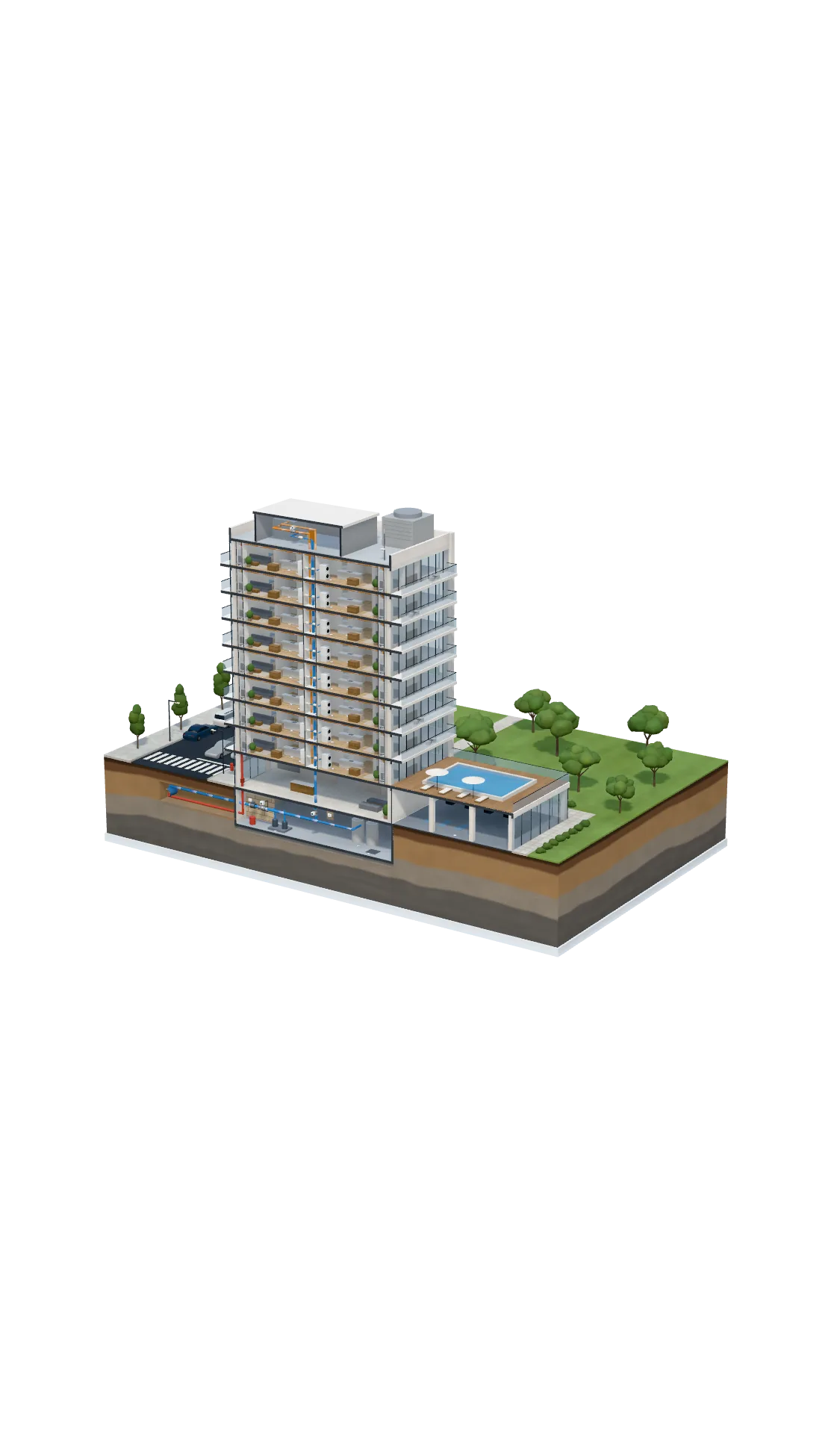
Occupied building · Business hours
Drag to turn the building. Select a label, or run a leak through the system.
The system
Detect, control and respond, in one managed program.
Sensors sit where leaks start and meters watch the flow. Valves close on the rules you set, and a 24/7 monitoring center follows each alert until your team has eyes on it.
3 layers and 16 close-ups in this building
Detect
Two ways to find a leak before it finds a unit.
Sensors sit where leaks start, and meters watch the flow for the leaks no sensor can reach.
8 close-ups · select one to zoom in
Point-of-leak
Flow-based
More about Detect
Eddy detects water through two layers running in parallel. Point-of-leak sensors sit where leaks happen: common areas and mechanical rooms (including elevator pits), inside suites at high-risk appliances, and behind walls at the risers that hide damage until cascade. Flow-based detection runs continuously at meters across the building, flagging continuous low flow, continuous use and extreme use against thresholds learned from your building's baseline.
- 3-in-1 sensors detect water, temperature and humidity
- Three flow thresholds, learned per building, not generic defaults
- Sensors are permitted near sprinkler infrastructure; valves are not
Where each device sits
- COMMON: Common & mechanical areas (incl. elevator pits) · Eddy H2O
- AMENITY: Pool, gym, spa decks · Eddy H2O
- IN-SUITE: Out-of-wall at laundry, kitchen, baths · Eddy H2O
- RISERS: In-wall domestic risers (concealed) · Eddy H2O
- HVAC + FAN COILS: Concealed HVAC sources · Eddy H2O
- SUITE METERING: Per-unit submetering + leak detection (LEED-eligible) · Eddy IQ
- BUILDING USAGE: Main consumption monitoring · Eddy Link
- H&C MAKE-UP: Closed-loop heating/cooling · Eddy IQ
Control
Valves that close the water before it closes the unit.
Valves close on the rules you set, automatically on a threshold or remotely from the dashboard.
4 close-ups · select one to zoom in
Respond
A live monitoring center that closes the loop.
Alerts go through Eddy's cloud to a 24/7 monitoring center, and an operator calls your team until someone has eyes on the water.
4 close-ups · select one to zoom in
What happens in a leak, step by step
- A washing machine supply hose bursts in a suite upstairs.
- Eddy H2O under the washer detects water and sends the alert over LoRaWAN.
- The building's gateway relays it. Your team and the 24/7 monitoring center are alerted at the same time.
- A shutoff rule closes the suite's Eddy IQ valve. The water stops at the source.
- An operator confirms the alert and calls your on-site team through the escalation protocol.
Automatic shutoff is configured per building. Some sites use operator-coordinated isolation instead.
Eddy vs FloLogic: feature by feature
Both systems include shutoff. Here is how the network, sensor coverage and response chain compare for larger buildings.
Network protocol
Eddy
LoRaWAN, long-range wireless engineered for concrete and steel.
FloLogic
WiFi-dependent connectivity.
Why it matters: WiFi fails in concrete cores, mechanical rooms and high-rise resident environments.
24/7 monitoring center
Eddy
In-house monitoring center; live operators support every alert.
FloLogic
Alerts and notifications via app and integrations.
Why it matters: An alert at 2 AM means nothing without action. Eddy puts a human on the line minutes after the alert.
Sensor ecosystem
Eddy
Humidity, temperature and water-presence sensors plus rope and probe attachments; common-area, in-suite and mechanical-room coverage.
FloLogic
Flow-sensing whole-supply shutoff. No native point-of-leak sensors, so it watches total flow, not the specific source.
Why it matters: Point-of-leak sensors near high-risk fixtures catch surface events that flow meters miss.
Building type focus
Eddy
Multifamily, commercial, hospitality, institutional, industrial and construction.
FloLogic
Residential and commercial; less proven in multifamily high-rise.
Why it matters: Multifamily high-rise has the most concentrated water risk. Network reach and response chain matter more there than anywhere else.
Insurance reporting
Eddy
Automated uptime, incident and response-time reports.
FloLogic
Carrier approvals (Chubb, PURE, State Farm); structured carrier-formatted reporting not the headline.
Why it matters: Approvals open the door; structured reporting closes the renewal conversation.
Talk to a leak-detection advisor about your portfolio
If you are evaluating FloLogic for a multifamily portfolio, the Eddy team can walk through where the network, sensor coverage and response chain change the math.
Talk to a leak-detection advisorGetting started is easy
Eddy connects detection, response and reporting in one place, with one team.
Build your system
Tell us about your building and get a customized leak protection recommendation in minutes.
Build your systemTalk to our team
Walk through the differences with a specialist tailored to your property type, construction stage and insurance requirements.
Talk to a leak-detection advisorFAQ
Is FloLogic shutoff hardware enough on its own?
FloLogic ships strong shutoff hardware with a long warranty. The shutoff is one piece of the system; point-of-leak sensors near high-risk fixtures and a monitored response chain are what turn detection into prevented damage.
Why does WiFi connectivity matter?
WiFi was designed for short-range residential connectivity. In concrete and steel high-rises it drops out across mechanical rooms, elevator shafts and dense suite walls.
Eddy's LoRaWAN backbone uses 915 MHz long-range radio that penetrates these environments, with one gateway typically covering two floors of a high-rise.
Who provides the shutoff valves?
Eddy does. Eddy Link drives shutoff valves up to 18 inches and reads water meters, all provisioned and configured by Eddy.
What insurance documentation does Eddy provide?
Automated uptime, incident and response-time reports. Operators have used the documentation to drive premium savings of up to 20%, with deductible reductions of up to 80% documented at individual properties.
More comparisons
See how Eddy compares with other systems.
Detection method, response chain, network protocol and insurance reporting, side by side.
All comparisons- Eddy vs Wint
- Eddy vs AlertLabs
- Eddy vs BrickEye
- Eddy vs ProSentry
- Eddy vs Aware Buildings
- Eddy vs Kairos Water
- Eddy vs Pipe Burst Pro
- Eddy vs LIKK Technologies