Water leak detection in Phoenix for commercial and multifamily buildings
Managed leak detection, 24/7 monitoring and automatic shutoff for multifamily and commercial buildings across the Valley.

- 150,000+
- active smart devices in the field
- $2.26M
- in water costs saved in 2025
- 24/7
- monitoring center
Why Phoenix buildings carry water risk
Most of the Valley's apartment and condo stock went up before 2000. Across Greater Phoenix, about half of homes in buildings of five or more units were built between 1960 and 1999, and in northeast Phoenix and west Mesa half or more went up between 1980 and 1999 alone. Those garden complexes and mid-rise condos are decades into their supply lines, valves and water heaters, and the ones built from the late 1970s to the mid 1990s belong to the polybutylene era.
The newer stock is arriving fast. Greater Phoenix is one of the busiest US metros for new housing, much of it apartments, and in Downtown Phoenix and north Tempe about half of apartment and condo homes were built since 2000. New plumbing fails too, usually at push-fit fittings, appliance connections and condensate lines. And the water is hard, 10 to 17.6 grains per gallon in the city's latest water quality report, which notes it can scale pipes and water heaters.
Then the heat. Phoenix logged 70 days at 110°F or hotter and 143 days at 100°F or more in 2024, its hottest year on record. Air conditioning runs most of the year, so condensate pans, drain lines and their connections work far more hours than in a cooler city. Eddy's point-of-leak sensors and flow monitoring watch around the clock, water can shut off automatically or on a remote command and the 24/7 monitoring center calls the building's contacts through the escalation protocol.
Where leaks start in Phoenix buildings
Aging plumbing in 1980s garden stock
Half or more of the apartment and condo homes in northeast Phoenix and west Mesa were built between 1980 and 1999. Supply lines, valves and water heaters that old fail slowly behind finished walls, and buildings from the late 1970s to the mid 1990s belong to the polybutylene era.
Hard water wears valves and heaters
Phoenix water runs 10 to 17.6 grains per gallon, and the city notes it can scale pipes and water heaters. Scale builds on valve seats and fixture supplies until a valve that held for years starts to seep, and flow monitoring catches the drift before the failure.
New plumbing under load
Greater Phoenix keeps permitting new apartment buildings at one of the fastest paces in the country. New buildings fail early at push-fit fittings, appliance connections and condensate lines, and monitoring from day one catches the failures that follow a building into occupancy.
Scarce, costly water
Phoenix has raised water rates several times since October 2023, and Arizona's Colorado River cuts deepen in 2027. Continuous flow monitoring surfaces the quiet waste and slow leaks that would otherwise run unseen.
Smart leak detection in Phoenix
A smart water leak detection system pairs wireless sensors and smart meters with automatic shutoff, so a Phoenix building catches a leak in seconds instead of discovering it from a ceiling stain. Eddy runs the full stack as one managed program with a staffed 24/7 monitoring center on the chain.
Sensors plus flow intelligence
3-in-1 wireless sensors watch high-risk spaces for water, temperature and humidity while smart meters flag abnormal flow against thresholds learned from the building's own baseline.
No building Wi-Fi needed
Devices run on Eddy's own LoRaWAN network at 915 MHz, a long-range radio that holds a signal through concrete. Gateways backhaul over Ethernet or LTE cellular, and with cellular backhaul monitoring stays up even if building internet goes down.
Shutoff plus a live response
Automatic valves close the moment a configured rule fires, and Eddy's monitoring center calls the building's contacts within minutes of every alert. Every confirmed event closes with a Leak Incident Report.
See how the Eddy system works, from sensor placement to the monitoring center.
Coverage map
How Eddy works in a Phoenix building.
Phoenix is one of the fastest-growing metros, with a lot of new plumbing, and in the desert quiet waste and slow leaks carry a real cost. Turn the building to see where sensors, meters and valves sit, then run a leak through the system, from the first drop to the monitoring center's response.
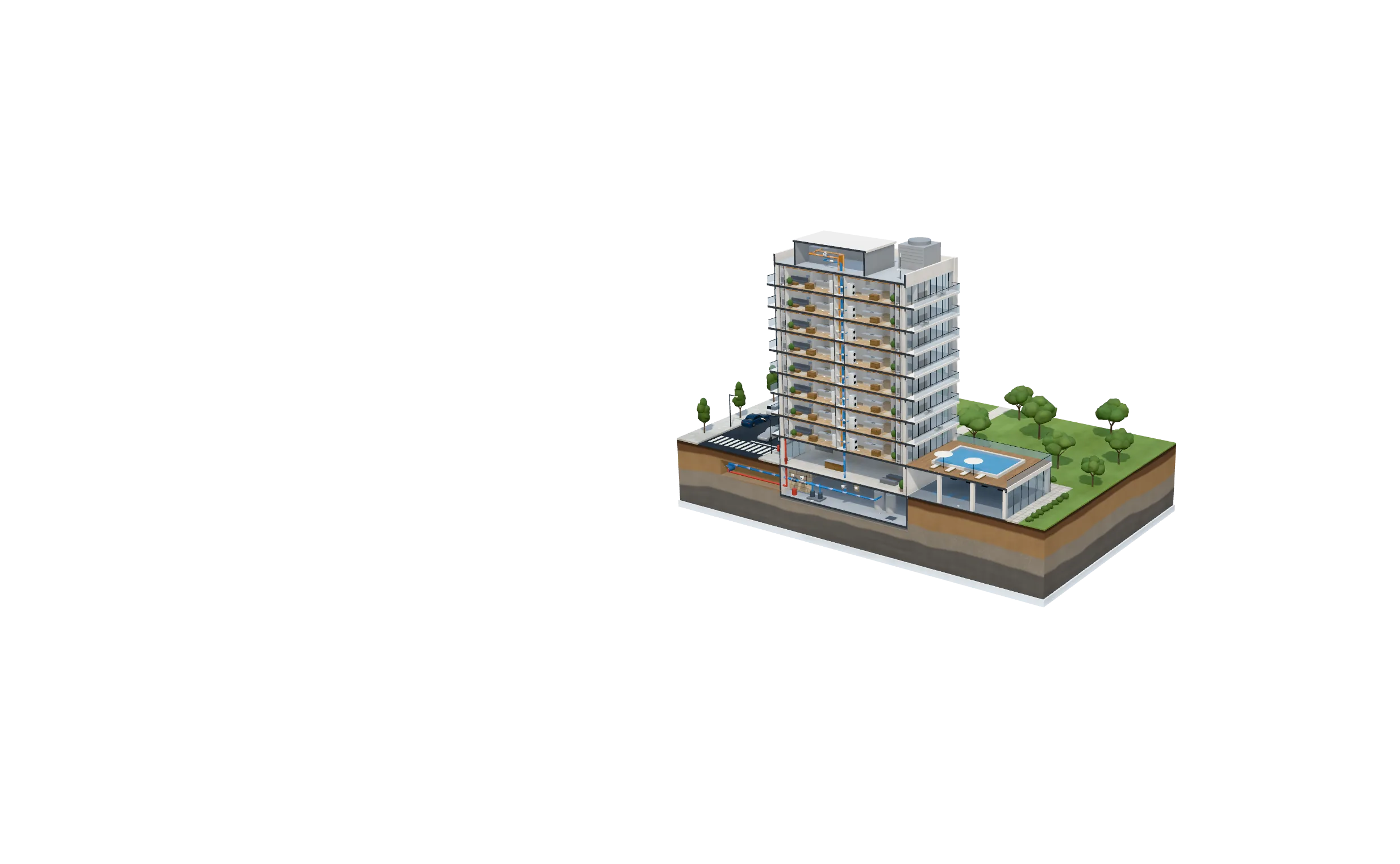
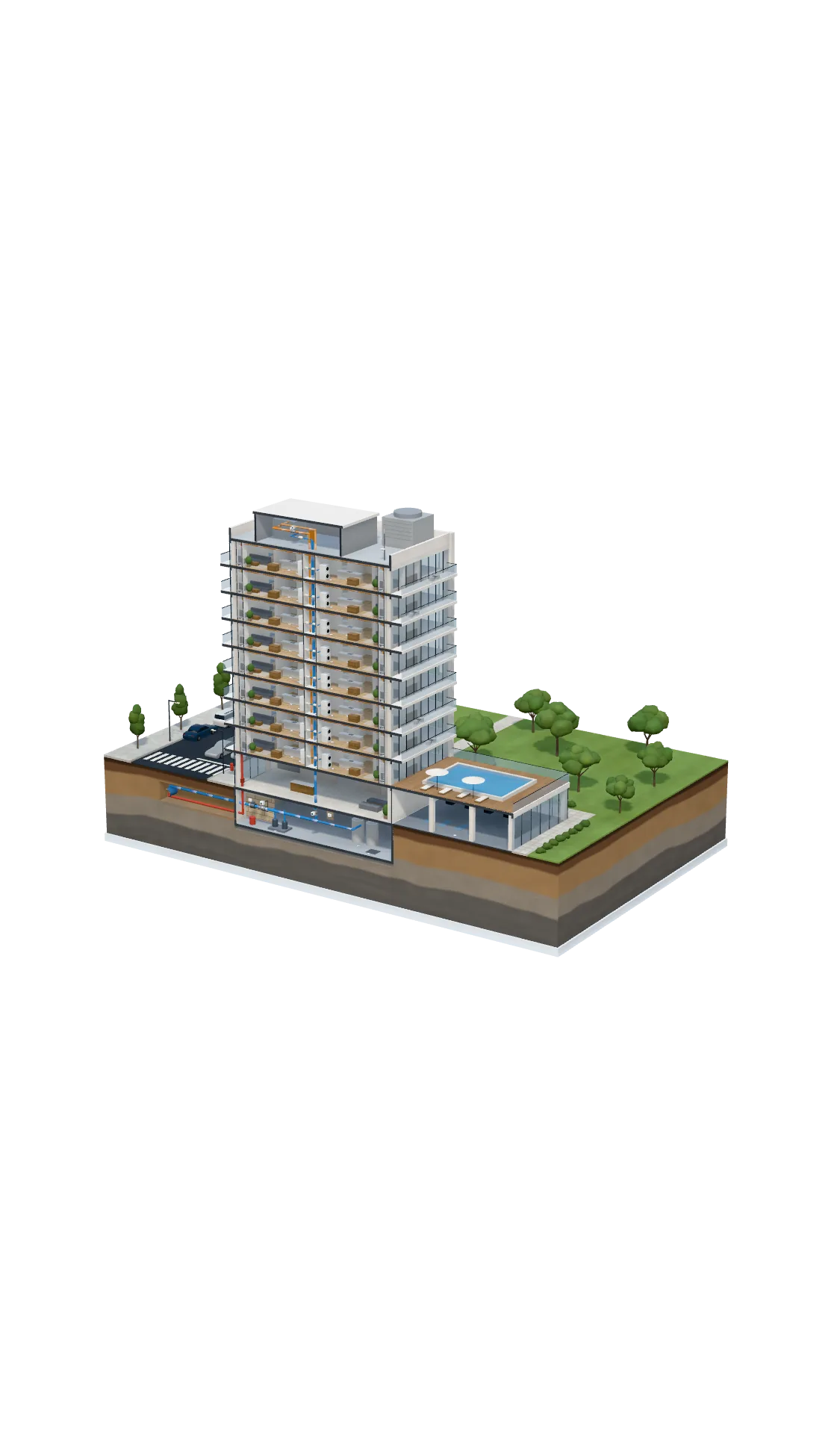
Occupied building · Business hours
Drag to turn the building. Select a label, or run a leak through the system.
The system
Detect, control and respond, in one managed program.
Sensors sit where leaks start and meters watch the flow. Valves close on the rules you set, and a 24/7 monitoring center follows each alert until your team has eyes on it.
3 layers and 16 close-ups in this building
Detect
Two ways to find a leak before it finds a unit.
Sensors sit where leaks start, and meters watch the flow for the leaks no sensor can reach.
8 close-ups · select one to zoom in
Point-of-leak
Flow-based
Control
Valves that close the water before it closes the unit.
Valves close on the rules you set, automatically on a threshold or remotely from the dashboard.
4 close-ups · select one to zoom in
Respond
A live monitoring center that closes the loop.
Alerts go through Eddy's cloud to a 24/7 monitoring center, and an operator calls your team until someone has eyes on the water.
4 close-ups · select one to zoom in
What happens in a leak, step by step
- A washing machine supply hose bursts in a suite upstairs.
- Eddy H2O under the washer detects water and sends the alert over LoRaWAN.
- The building's gateway relays it. Your team and the 24/7 monitoring center are alerted at the same time.
- A shutoff rule closes the suite's Eddy IQ valve. The water stops at the source.
- An operator confirms the alert and calls your on-site team through the escalation protocol.
Automatic shutoff is configured per building. Some sites use operator-coordinated isolation instead.
Smart sensors at every leak point
Eddy places point-of-leak sensors and smart flow meters where water damage actually starts in Phoenix buildings, from the mechanical room to a laundry hose, so a leak is caught at the source and shut off before it spreads.
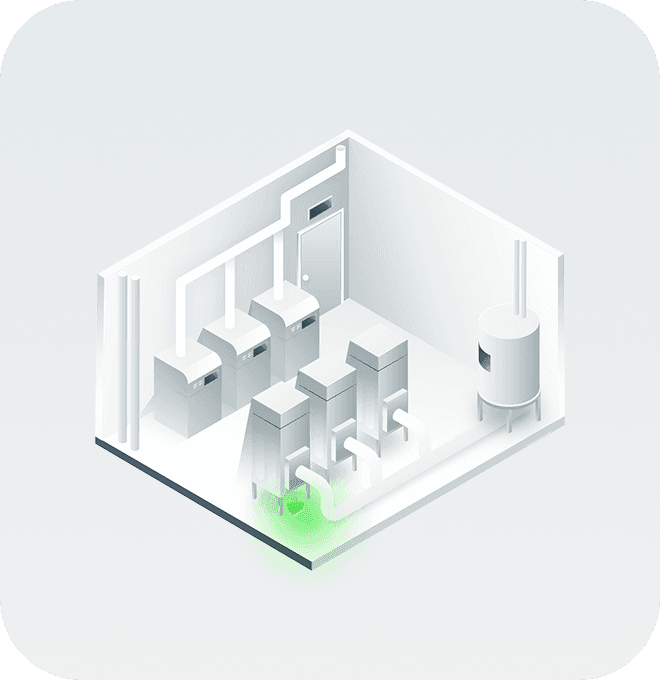
Mechanical rooms
Boilers, water heaters and main risers, where a single failure floods fast.

HVAC and fan coils
Heat exchangers and condensate lines that drip behind walls and ceilings.
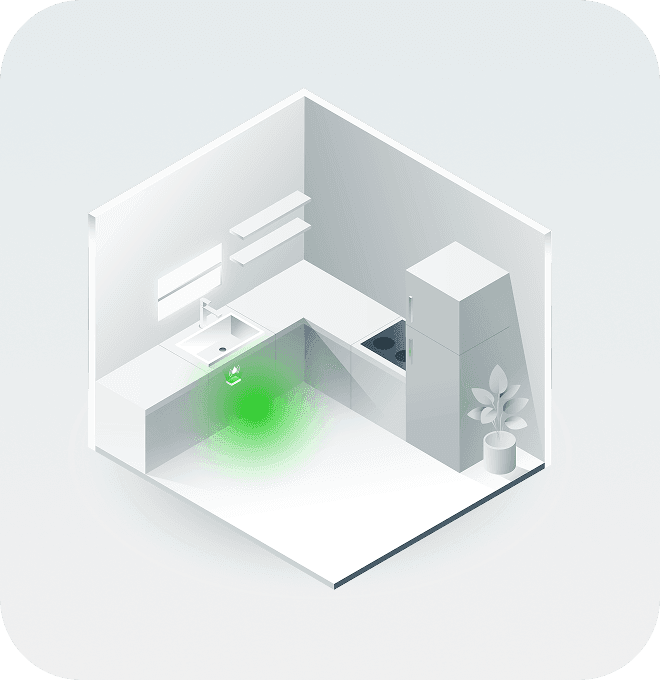
Kitchens
Supply lines, shutoffs and appliance connections under and behind the sink.
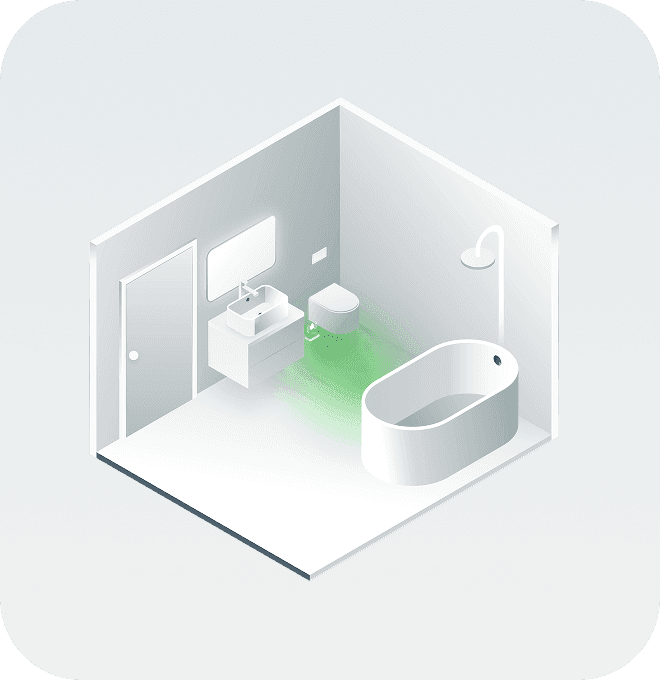
Bathrooms
Toilets, vanities and concealed in-wall fixtures on every floor.
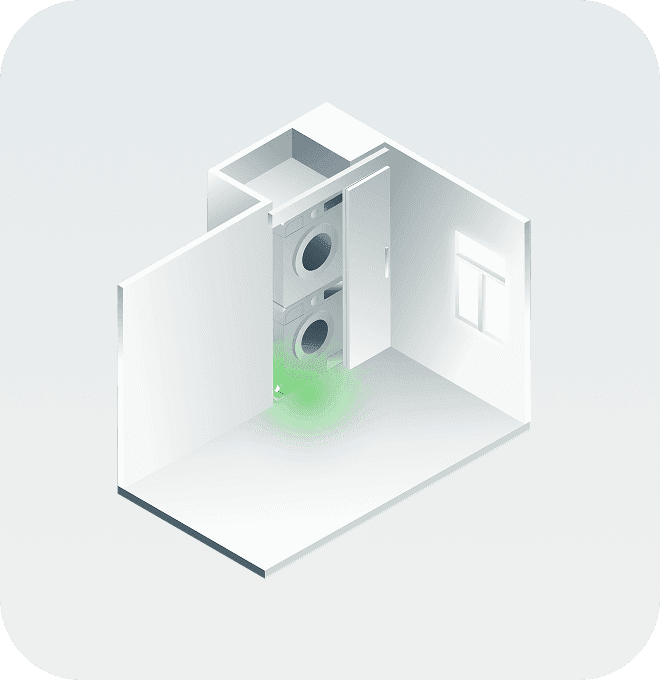
Laundry
Washer hoses and laundry connections, a top source of overnight leaks.
Every minute changes the bill.
A leak gets bigger the longer it runs. Eddy detects in seconds and the monitoring center escalates within minutes, so the same failure is contained around minute two. Unmonitored, an after-hours leak runs six to eight hours before anyone arrives.
The leak starts at minute zero. Eddy contains it around minute two. Unmonitored, the same leak runs six to eight hours before staff arrive, and that red stretch is the avoided claim.
Build your system
Design your building's leak protection.
Two minutes of quick questions gets your building the right protection, previewed instantly.
- Sized to your asset class and budget
- Modular. Adjust anything before pricing
- An Eddy team member calls soon after you submit

Sensors, meters and shutoff, backed by a 24/7 monitoring center.
What stage is the project at?
Pick one to start. We tune every question and the system around it.
 New constructionFrom breaking ground to substantial completion.
 Existing buildingInstalled in existing buildings with minimal disruption to residents and operations.
About two minutes.
Colorado River cuts and Phoenix's drought plan
Arizona is in a Tier 1 Colorado River shortage for 2026, and under federal guidelines adopted in August 2026 its supply is set to drop by 760,000 acre-feet a year in 2027 and 2028 if Arizona, California and Nevada carry out their proposed sharing agreement. A large share of Phoenix's drinking water comes from the river through the Central Arizona Project. As of July 31, 2026, the city remained in Stage 1 of its Drought Management Plan, said it could reach Stage 2 by the end of 2026 with possible drought surcharges and asked residents and businesses to start by checking for leaks. Documented flow monitoring turns that request into a standing record.
A team behind every alert
A 3 a.m. alert is one chime. Nobody is awake to hear it.
Fast response is not just the hardware. The technology sees the water in seconds, and the managed service behind it, a monitoring center that calls your team within minutes, turns that into a contained event before it becomes a claim.
Tuned by real events
Built over a decade in operating buildings.
Eddy has been inside buildings since 2014. Sensor placement, alert thresholds and the monitoring-center playbook are tuned by what real water events across our monitored properties keep teaching us.
Built for the building
Sized to how the water system behaves.
Multi-family stacks, commercial towers, hospitality suites, course-of-construction projects. Each water system has its own failure pattern. The coverage map, response chain and shutoff sequence are scoped to the property in front of us, not a template.
Detect, contain, document
Every event leads to a closed incident.
Sensors find where water escaped. Automatic shutoff isolates the affected zone. The 24/7 monitoring center calls your team within minutes and stays on it until it's closed, with a Leak Incident Report on file.
Built for fast-growing desert stock
Eddy protects the new multifamily and commercial buildings driving Phoenix's growth, watching for both leaks and quiet waste, with escalation and shutoff handled around the clock by the monitoring center.
Eddy at work in buildings like yours
Multi-family
A slow drip the eye could never catch. Smart metering saw it anyway.
Vancouver, British Columbia
A minor leak on a closed-loop cooling system showed up as continuous low flow on the make-up line, with nothing to see or hear. Eddy's smart metering flagged the abnormal pattern off-hours, and the superintendent isolated the chiller-room leak before it grew into a mechanical event.
- Facility operator
- Property manager
- Asset owner
Construction
A leak on a floor still being built. The water zone shut off in the same second.
North Bethesda, Maryland
During active construction, concealed bathroom piping began to leak before anyone had moved in. Eddy detected the moisture and automatically shut off the unit's water zone valves in the same second, containing the leak with no impact to finished work or the construction timeline.
- Builder or GC
- Risk manager
- Facility operator
Multi-family
Water under a dishwasher at 1:15 PM. It never left the suite.
Hamilton, Ontario
A dishwasher leak in a newly delivered community could have sent water down through several floors. A unit-level sensor caught it at the source, building staff confirmed it within minutes, and the event stayed inside the single suite.
- Property manager
- Asset owner
- Facility operator
Solutions for every building
Eddy protects every asset type the same way, with monitoring and shutoff tuned to how each building's water system behaves.
Multifamily and condos
Protect every suite and riser across high-rise and mid-rise residential.
Commercial
Keep Class A offices and mixed-use towers dry, floor by floor.
Construction
Cover active sites where water damage is a leading cause of loss.
Hospitality
Guard guest floors and back-of-house without disrupting the stay.
Institutional
Safeguard campuses, hospitals and labs where contents are irreplaceable.
Industrial
Watch process water and facility systems around the clock.
Phoenix water leak detection FAQ
Do you serve the Phoenix Valley?
Yes. Eddy protects commercial and multifamily buildings across Phoenix and the surrounding Valley, including Scottsdale, Tempe, Mesa, Chandler, Gilbert, Glendale and Peoria.
Can Eddy help cut water waste, not just leaks?
Yes. Continuous flow monitoring surfaces quiet, ongoing waste as well as sudden leaks, which matters in a city that asks residents and businesses to start conserving by checking for leaks.
Can you protect new construction?
Yes. Water damage is a leading cause of builder's risk loss, and the same system covers a building from construction through occupancy, catching the early fitting and supply-line failures common in new builds.
Who pays the deductible when a leak starts in a condo unit?
It depends on your association's documents, and Arizona's Condominium Act requires the association to tell each owner in writing every year what the owner's responsibility is for the association's insurance deductibles and the amount of each one. Eddy documents every event, so the board and owners can see where the water started and when it was stopped.
Can Eddy protect a unit while the owner is away for the season?
Yes. Many homes in Scottsdale and Mesa are held for seasonal or occasional use. Point-of-leak sensors and flow monitoring watch the unit whether anyone is home or not, water can shut off automatically or on a remote command and the monitoring center escalates to the building's contacts, not to an owner in another state.
How Eddy works
What is Eddy Solutions?
Eddy Solutions is managed water leak detection for builders, commercial asset managers and property managers, hospitals, hotels and conference centers, data centers and multifamily residential buildings across the Phoenix Valley. It combines point-of-leak and flow sensors, automatic shutoff, building wireless connectivity, a 24/7 monitoring center and insurance-grade reporting into one program from one vendor, so a leak is detected, contained, escalated and documented without your team running the response.
Eddy monitors 150,000+ active devices across North America and has prevented an estimated $98M (USD) in property damage last year alone. Aon's independent study found Eddy would have positively affected 58% of water-loss claims in commercial real estate.
How do we choose a commercial water leak detection company in the Phoenix Valley?
Look for five things. Sensors where leaks start, not only a meter on the main. Shutoff valves that close on their own when water runs. A staffed monitoring center that calls your team instead of only sending an app alert. Wireless coverage that holds a signal through concrete to mechanical rooms and parking levels. And a documented record of every event that your insurer can read.
Eddy covers all five for buildings across the Phoenix Valley, from a single tower to a full portfolio, with 150,000+ active devices in the field.
What happens after hours?
The 24/7 monitoring center is the after-hours response. Trained operators confirm every alert, escalate per the building's contact list, support the on-call contact, and stay on the line until the water is off and the response is verified.
Will this affect our insurance?
Yes. Eddy Solutions' technology is approved by most insurers across North America to provide deductible or premium savings. Given differences in asset types and building risk profiles, insurance incentives are not uniform. For specific insurance questions related to your property in the Phoenix Valley, please reach out directly to sghanbarian@eddysolutions.com.
How is the system sized for a building, and what does it cost?
Eddy's team walks the building, or reviews the construction drawings, and produces a tiered design matched to the asset class, water systems and insurance program. Our first step is an exploratory call with the relevant stakeholders to understand the problem you are looking to solve. Proposals come from our technical team in 7 days or less.
You can also get started immediately with our Build Your System tool at eddysolutions.com/build-your-system.
Do we have to open walls to install Eddy?
No. Sensor installs need no drywall cuts. Wireless sensors sit where leaks start, at fixtures, appliances, fan coils and the foot of each riser, and Eddy provisions and configures the meters and valves on the lines that need them.
What is smart water leak detection?
Smart water leak detection uses connected sensors and flow meters to watch a building's plumbing in real time, instead of waiting for someone to find a leak. Point-of-leak sensors catch water at the source and smart flow meters spot an abnormal run or a burst riser, and the system can shut the water off automatically or on a remote command. With Eddy, a 24/7 monitoring center acts on every alert, so detection turns into a response, not just a notification.
How is commercial water leak detection different from a home leak detector?
A home leak detector is usually a single sensor that pings an app. Commercial and multifamily leak detection has to cover dozens of risers, suites and mechanical rooms, hold a signal through concrete and steel and produce the documented response insurers expect. Eddy is built for that scale, with building-grade LoRaWAN wireless, point-of-leak and flow coverage across the property, automatic shutoff up to building mains and a managed 24/7 monitoring center.
What is the difference between leak detection and water leak protection?
Leak detection finds the water. Water leak protection stops the loss. Detection on its own is an alert that still needs someone to act on it. Eddy pairs detection with automatic shutoff and a 24/7 monitoring center that escalates the alert and closes the water, so the building is protected, not just alerted.
Does Eddy work for both multifamily and commercial buildings?
Yes. Eddy protects multifamily and condo towers, Class A offices and mixed-use buildings, hospitality, institutional and industrial properties and active construction sites. The same managed program tunes the sensor density, shutoff strategy and reporting to how each building's water system behaves. See the full product suite at eddysolutions.com/products.
Sources and further reading
- U.S. Census Bureau, "American Community Survey 2020-2024 5-year estimates, Table B25127, Tenure by year structure built by units in structure (Phoenix-Mesa-Chandler metro, Phoenix City Northeast PUMA, Mesa City West PUMA, Tempe City North PUMA, Phoenix Downtown and Sky Harbor PUMA)", 2020-2024 estimates
- U.S. Court of Appeals for the Fifth Circuit, "Richard v. Hoechst Celanese Chemical Group, No. 02-41377", December 19, 2003
- U.S. Census Bureau, "Building Permits Survey, annual permits by metropolitan area (CBSA), 2025", 2026
- City of Phoenix Water Services Department, "2025 Water Quality Report", 2026
- National Weather Service Phoenix, "2024 year in review", January 5, 2025
- City of Phoenix Water Services Department, "2023-2025 rate increase information for Phoenix Water Services and stormwater excise tax", accessed October 2026
- KJZZ, "A new Colorado River plan is here, and Arizona will take the biggest water cuts", August 21, 2026
- Central Arizona Project, "Reclamation declares Tier 1 shortage for 2026", August 2025
- City of Phoenix, "Phoenix prepared as federal framework outlines potential cuts to Arizona's Colorado River supply", July 31, 2026
- Arizona State Legislature, "Arizona Revised Statutes 33-1253, Insurance", current
- U.S. Census Bureau, "American Community Survey 2020-2024 5-year estimates, Tables B25004 (vacancy status) and B25001 (housing units), Scottsdale and Mesa", 2020-2024 estimates